My adventures with Elizabeth began in the 1970s, when my sister-in-law Helen one day talked about Elizabeth and the German Garden (1898), and took me on a memorable imaginary wander to enjoy the overwhelming scent of the lilacs. I longed to go there. By the 1980s, I was reading the book myself, not only revelling in that half-mile of lilacs, but joining Elizabeth sitting in the evening garden, listening to the owls, and hankering after her journey to the Baltic in the winter’s snow.
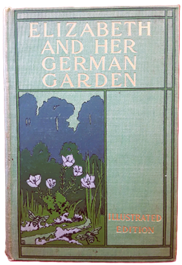
By the 1990s, a friend Janet and I would walk our dogs in Peckham Rye Park in south-east London, often talking about Elizabeth. Janet introduced me to All the Dogs of My Life (1936) (of course!) and also to The Adventures of Elizabeth in Rügen (1904). Rügen became top of my own Adventure list. By 2002 I could safely leave the dogs with my by-now adult children, and off I set to walk the island (or parts of it) in her footsteps. I based myself at Binz, with the curve of its long beach reaching north to the chalk cliffs of Sassnitz,
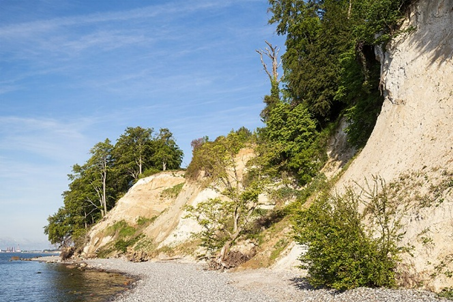
Coast_near_Sassnitz_05.jpg (3100×2066)
and south into more cliffs topped by the forest, beyond which lay Sellin. For ten days I roamed the beech woods, taking in the grave of an unknown Finnish Soldier who had died in the Napoleonic Wars,

https://upload.wikimedia.org/wikipedia/commons/3/3a/Finnischer_Krieger_in_der_Granitz_01.jpg
climbing the scary staircase at the Jagdschloss Granitz, the sandy beaches of Thiessow.
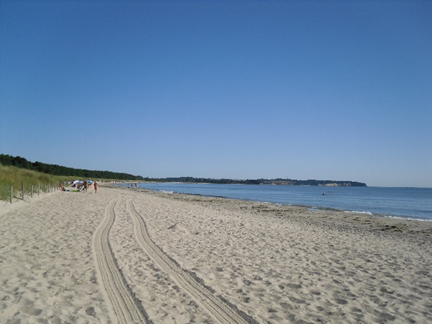
Strand_in_Thiessow_mit_Blickrichtung_nach_Lobbe,_2013.jpg (3648×2736)
I took very reliable buses to Sassnitz, one of the settings for another favourite novel, Theodor Fontane’s Effi Briest (1895),and to Cap Arcona, where the lighthouse was less scary to climb. After ten days, I took the ferry to Hiddensee for a different experience. Here I hired a bicycle and whizzed up and down the island, or walked along the paths on the top of the dykes. I visited two churches with beautifully decorated organs, and wondered if Elizabeth had played these instruments when she visited. When I left the island for Stralsund on the mainland, the ship ran alongside a procession of swans swimming in single file: there must have been around a thousand of them.
Fast forward five years, and I’d moved to Suffolk. Semi-retired, I enrolled for a course at the Institute of Continuing Education in Cambridge. The immediate attraction was Edith Wharton’s The House of Mirth (1905), but one of the other participants was Jennifer Walker. Imagine my surprise when I discovered that here was someone who knew much, much more than I did about EvA (as we came to call her) and not only that, Jennifer lived two miles from me![1] Many conversations took place in our shared car journeys to and from Cambridge and on walks in the Suffolk country side with her dog Penny.
In 2010 together we set out to explore the fictional route of The Caravaners (1909).
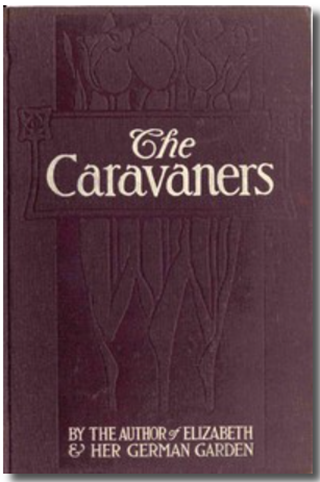
EvA’s description of the journey made it easy to follow on today’s Ordnance Survey maps. But we were in for some surprises. Having arrived at Borough Green we drove up a steep narrow hill and arrived at Troseley Country Park,
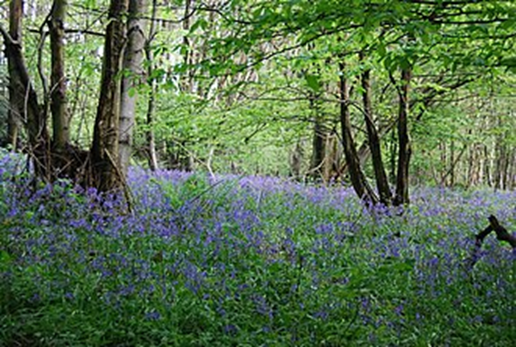
Bluebells,_Troseley_Country_Park_-_geograph.org.uk_-_3539920.jpg (640×430)
where Jennifer’s face lit up in amazement when she realised that this was where Sir Sydney Waterlow, father-in-law of Elizabeth’s sister Charlotte, had built his mansion, and that the hill we had just come up was the very one up which the Baron and Edelgard had struggled to Panthers. Knowing we were on the right track we traced her journey to Mereworth, and then to Dundale Farm, definitely ‘improved’ since the visit of the Caravaners.
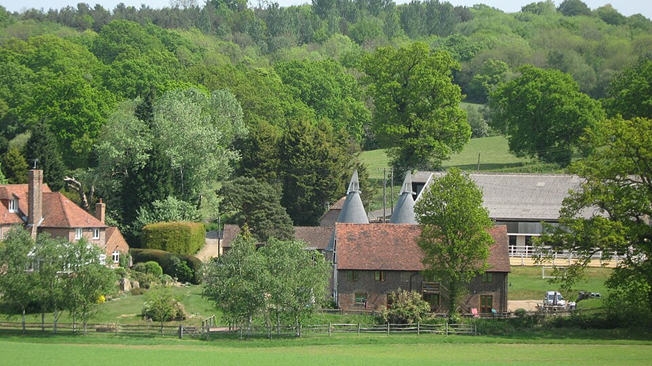
We passed through Wadhurst, imagining the scoffing of the youth at the Baron lying on his berth in full view.
Fast forward a further dozen years. I moved for family reasons to the Kent-Sussex borders to Broad Oak Brede near Rye. Re-reading the novel, I came across the lines: ‘At the four cross roads beyond Brede, on the party’s pausing as usual to argue over the sign-post . . .’ (p. 248 in the Virago edition) Well, reader, the only four cross roads beyond Brede are just 50 yards from my gate! Even though Elizabeth’s sign-post is no longer there, I think I can safely say that ‘Elizabeth was here’.
[1] Jennifer Walker’s biography of von Arnim, entitled Elizabeth of the German Garden – A Literary Journey, was published by Troubador Publishing in 2013.


3 thoughts on “ADVENTURES WITH ELIZABETH Diana Hirst ”
I have often wondered about your life after leaving East Dulwich. Needless to say you continue to be as interesting as you always were during our dog walks. I’m so glad to hear about further adventures with Elizabeth von Arnhem and I am envious that you made it to Rugen. I’d love to hear more.
Hi Diana, lovely to hear from you.
What a wonderful post. Marvellous to trace EvA’s journeys & especially serendipitous to find the route of ‘The Caravaners’ so close to home. Thank you for sharing.